
Full-Scale EL Inspection Reveals Hidden Defects at Utility-Scale Solar Facility in New York
Jun 12
2 min read
Updated: Jun 16


Project Overview
Aura PV successfully completed a comprehensive drone-based Electroluminescence (EL) inspection for a utility-scale solar project in New York, USA.
The project covered more than 625,000 square feet of site area and over 305,000 square feet of installed photovoltaic modules. Unlike traditional sampling methodologies, the inspection included 100% EL imaging coverage of all installed modules, providing complete visibility into asset condition.
Project Scope
Location: New York, USA
Site Area: 625,000+ sq ft
PV Module Area: 305,000+ sq ft
Inspection Method: Drone-Based Electroluminescence (EL)
Coverage: 100% Module Inspection
Reporting Turnaround: 48 Hours
The Challenge
The asset owner required a detailed assessment of module health to establish a reliable baseline for long-term asset management and operational planning.
While visual inspections and infrared thermography are commonly used during operations and maintenance programs, these methods cannot identify many forms of internal cell damage that may already be affecting system performance.
Undetected defects can gradually develop into measurable energy losses, warranty disputes, and reduced asset value over time.
Inspection Methodology
Aura PV deployed its drone-integrated EL inspection platform during scheduled nighttime inspection windows.
The inspection process included:
Full-site drone-based EL imaging
Automated defect identification and classification
GPS-based module positioning
SaaS-based defect management and reporting
Priority-based corrective action recommendations
All inspection data was processed through the Aura PV asset intelligence platform, providing traceable module-level documentation and repair tracking.
Key Findings
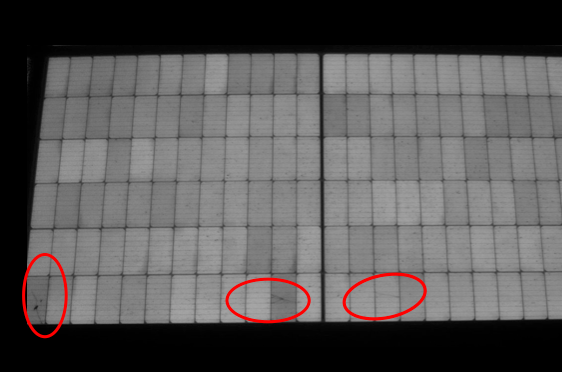
The EL inspection identified approximately 3.2% of modules exhibiting internal defects.
Detected defect types included:
Micro-cracks
Broken grid lines
Dark cells
Cell interconnection anomalies
More than 1% of modules were classified as requiring immediate corrective action due to their potential impact on system performance.
Business Impact
Based on the inspection findings, the asset owner initiated a targeted remediation program focused on the highest-priority modules.
The corrective actions are expected to recover an estimated 2–3% of annual energy production while reducing future operational risks.
Additional benefits include:
Establishment of a module-level health baseline
Improved maintenance prioritization
Enhanced warranty claim support
Increased confidence for investors and stakeholders
Long-term asset performance visibility
Why EL Inspection Matters
Electroluminescence inspection remains one of the most effective methods for identifying internal photovoltaic module defects that cannot be detected through visual inspection or infrared thermography alone.
By providing module-level visibility into hidden degradation mechanisms such as micro-cracks, PID, and cell damage, EL inspections enable asset owners to make informed decisions before performance losses become financially significant.
Conclusion
This project demonstrates the value of full-coverage EL inspections for utility-scale solar assets. By identifying hidden defects early and providing actionable intelligence through GPS-tagged reporting and digital asset management tools, Aura PV helps owners protect energy production, reduce risk, and maximize long-term asset value.
Inspection Technology: Drone-Based Electroluminescence (EL)
Report Delivery: 48 Hours
Data Output: GPS-Tagged Defect Mapping & Prioritized Action List
Platform: Aura PV Asset Intelligence Platform
Inspection Findings Overview
The EL inspection identified multiple defect categories across the site, including:
Cell degradation
Inactive cell regions
Internal electrical discontinuities
Surface contamination impacts
Hail-related damage

Comments